Is Homemade Dog Food Actually Healthy? What Goes Into a Nutritionally Complete Meal

Why do so many pet parents want to feed homemade dog food? Because it offers what most store-bought foods can't: full control over ingredients, real whole foods, and the simple joy of making your dog's dinner yourself. But research shows only 6% of home-prepared meals are nutritionally complete, and keeping a balanced routine going week after week is harder than it looks. Here's an honest look at both sides, and a human grade alternative that keeps the best parts of homemade.
Why Do Pet Parents Choose Homemade Dog Food?
The appeal is real, and it usually comes down to a few heartfelt reasons:
- You know exactly what's in the bowl. No mystery ingredients, no fine print. Just foods you can see, smell, and pronounce.
- Fresh, whole ingredients. Many pet parents want to move away from highly processed food and toward meals that look like, well, food.
- It's personal. Cooking for your pup is an act of love. You can tailor every meal to a picky eater, a sensitive tummy, or a favorite protein.
Those instincts are good ones. Dogs deserve real food made with care. The trouble isn't the intention. It's the execution.
Where Does Homemade Dog Food Fall Short?
The main concern is nutritional completeness. A 2025 Dog Aging Project study published in the American Journal of Veterinary Research analyzed 1,726 home-prepared meals from real households and found that only 6% had the potential to be nutritionally complete. 44% percent were missing at least one essential nutrient entirely.
And it's not just home cooks winging it. An earlier study in the Journal of the American Veterinary Medical Association found 95% of 200 published homemade recipes, including many written by veterinarians, were deficient in at least one essential nutrient.
Remember, this isn't a story about pet parents failing their dogs. The intention to care for your pup is a beautiful thing. It's a story about how genuinely hard it is to balance a bowl from scratch. Calcium, trace minerals, vitamin E, and omega-3s are easy to miss and nearly impossible to eyeball.
What Are the Most Common Homemade Dog Food Mistakes?
Even the most devoted home cooks tend to slip up in the same predictable ways:
- Skipping the calcium: meat-heavy meals without a calcium source create mineral imbalances over time
- Using unsafe ingredients: onions, garlic, grapes, seasonings, and excess salt are off the menu
- Guessing portions: "a little of this" quietly adds up to nutritional gaps
- Relying on recipe rotation: researchers found many recipes share the same deficiencies, so variety alone doesn't necessarily close the gaps
- Improvising substitutions: swapping oils or leaving out a supplement can undo an otherwise balanced recipe
Why Is Homemade Dog Food So Hard to Sustain?
Two reasons, and they compound each other.
Nutritionally, balance isn't a one-time achievement. It has to hold up for years. A skipped supplement or improvised swap, and the gaps creep back in.
Practically, life happens. Homemade feeding means sourcing, cooking, portioning, storing, and repeating, on the weeks you travel, the nights you work late, and every busy day in between. Most routines that start strong in January look very different by June. That's not a character flaw. That's being human.
What's a Human Grade Alternative to Homemade Dog Food?
The Honest Kitchen actually started with a homemade recipe. In 2002, founder Lucy Postins began preparing fresh food in her San Diego kitchen for her Rhodesian Ridgeback, Mosi, whose chronic ear infections cleared up after she overhauled what was in his bowl. Lucy spent countless hours mixing fresh ingredients and testing recipes for Mosi. But home-cooking was messy and time-consuming. Looking for a better way, she experimented with gently dehydrating whole foods—preserving their nutrients while making mealtime easier. When she saw the incredible difference in Mosi, she knew other pets (and their people) could benefit too. And with that, The Honest Kitchen was born.
That kitchen experiment eventually became the world's first human grade pet food. Human grade means every ingredient, and the facility it's made in, meets the same standards as the food on your own plate. The Honest Kitchen's recipes are produced in a human food facility that meets more than 100 FDA and USDA safety standards, so you get the ingredient quality that draws pet parents to homemade cooking, with the complete, balanced nutrition already handled.
You keep everything pet parents love about homemade, the real ingredients and the care, without carrying the balancing act alone. In our customer surveys, 80% of pet parents reported improved digestion and 77% saw improved energy after switching.
A few ways in, depending on how hands-on you want to be:
-
Base Mixes: If you're not ready to give up cooking for your dog, you don't have to. Base mixes are dehydrated blends of whole food veggies, fruits, and vitamins designed to pair with the protein you provide. Brown the ground turkey, dice the chicken, or use whatever fresh meat is on your menu, then stir it into the rehydrated base. The recipe math is already solved: when prepared as directed with added protein, the meal is complete and balanced. It's the closest thing to homemade cooking with a nutritional safety net, and it directly closes the gap that trips up 94% of home-prepared recipes.
- Wholemade Dehydrated: a ready to serve meal made from real, recognizable ingredients. All the homemade taste, none of the nutritional gaps. Gentle dehydration removes only the moisture, preserving the nutrients and natural digestibility of whole food ingredients. Just add warm water and you've got a homecooked-style meal in minutes. It's the same real food philosophy behind homemade, in a recipe type that's far easier to sustain day after day: no shopping lists, no prep time, no supplement math.
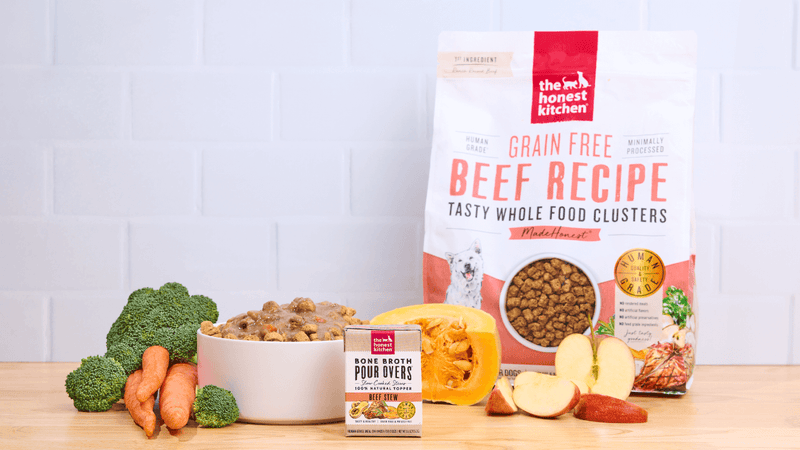
- Clusters: Clusters are gently cooked, not extruded like conventional kibble. Whole food ingredients are mixed in small batches, cold pressed, then slow roasted and dehydrated at lower temperatures, which helps protect the nutrients and flavor that high-heat processing can strip away. The result is a scoop-and-serve dry recipe made with ingredients you can pronounce. It's the easiest way to bring the whole food quality of homemade to the bowl, with zero prep and complete, balanced nutrition in every batch.
- Wet food: The Honest Kitchen's wet food recipes are chef crafted in a human food facility and slow cooked in small batches to lock in flavor and nutrients. Every recipe is complete and balanced, meaning it can be served as your pup's entire meal, whether that's every day or in rotation with dry recipes. For pet parents drawn to homemade because of the fresh, high-moisture texture dogs love, wet food delivers that same appeal straight from the box, with the nutritional guesswork already done.
- Toppers: Toppers are the middle ground between cooking from scratch and a full switch. Pour or spoon one over your pup's everyday food to add real whole food ingredients, extra moisture, and a boost of flavor and nutrition. One thing to know: toppers are meant to complement a complete and balanced recipe, not replace it. They're intentionally supplemental, so they shouldn't be served as a standalone meal. If you love the ritual of preparing something special for your dog, a topper scratches that itch in about ten seconds.
The Best of Both Bowls
Picture a Tuesday night. There's leftover ground turkey from your own dinner, and your pup is doing the hopeful dance by the bowl. Scoop in a Base Mix, add warm water, stir in your turkey, and dinner is served: your protein, any protein you like, on top of nutrients that are already set to go. Human grade throughout, nutritionally preserved through gentle dehydration. And on the weeks when even that feels like a lot, gently cooked Clusters are ready to scoop.
That's the honest middle ground. You still get to cook for your dog. You just never have to wonder whether the bowl is complete.
FAQ: Homemade Dog Food
Is homemade dog food healthy for dogs?
It can be, when it's complete and balanced. But research shows most home-prepared meals are missing at least one essential nutrient, so recipes should be formulated to AAFCO or veterinary nutrition standards.
How many homemade dog meals are nutritionally complete?
Very few. A 2025 Dog Aging Project study of 1,726 home-prepared meals found only 6% had the potential to be nutritionally complete, and 44% were missing at least one essential nutrient.
What should you never put in homemade dog food?
Never include onions, garlic, grapes, raisins, chocolate, or excess salt. These are toxic or harmful to dogs even in small amounts.
What is a good alternative to homemade dog food?
A Dehydrated Base Mix offers the best of both worlds: you add your own fresh protein, and the mix supplies the whole food produce and vitamins that make the finished meal complete and balanced. You keep the hands-on, fresh food experience of homemade, minus the nutritional guesswork.
Prefer to skip cooking entirely? Dehydrated recipes deliver a homecooked-style meal with just warm water, wet food offers fresh appeal straight from the box, gently cooked Clusters cover everyday convenience, and toppers add whole food nutrition to the bowl your dog already loves.
Explore Base Mixes and our full human grade lineup and see the honest difference in the bowl.